
A country with incredible biodiversity, Costa Rica also has lush rainforest, pristine jungle-fringed beaches, hot springs, and other-worldly volcanoes.
Honestly, there is no bad time to visit this Central American country. It all depends on what you want to see and do, and also on your budget and weather preferences.
In this guide on the best time to visit Costa Rica, I will give you a month-by-month breakdown to help you plan your Costa Rica vacation.
A Bit About Costa Rica

With San José as its capital, Costa Rica is a Central American country with no standing army. The country has one of the highest literacy rates in the western hemisphere, and it is often considered Central America’s intellectual nucleus.
Geographically, the country borders the Pacific Ocean to the west and the Caribbean Sea to the east and has a year-round tropical climate.
About a third of the nation’s landscape is covered by dense evergreen forest, which is home to incredible biodiversity.
Costa Rica is Central America’s most-visited country. While Spanish is the main language there, many Ticos (locals) can speak English.
The Best Time to Visit Costa Rica
If you want to enjoy warm weather, clear skies, beautiful beaches, and wildlife, visit Costa Rica during the peak tourist season or the dry season (December to April).
If you want to enjoy low crowds, limited rainfall, plenty of sunlight & greenery, and wildlife, visit Costa Rica during the hedge months of May to August.
For water adventures and lush greenery, visit Costa Rica during the peak rainy months of September and October or the shoulder period of November to the middle of December.
The Climate in Costa Rica
Costa Rica has only two seasons – the dry season (December to April) and the green season or rainy season (May to November).
The transition period between the dry and green seasons is known as the hedge or shoulder season which includes May through August and November to mid-December.
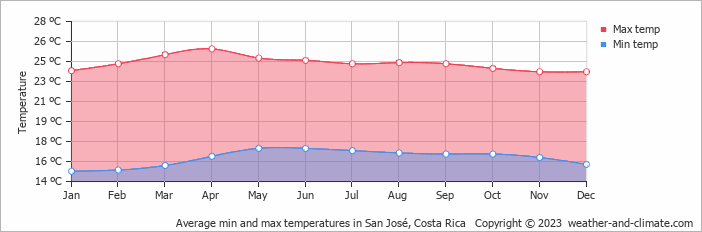
Dry Season: The minimum temperature ranges between 22°C and 24°C while the maximum temperature ranges between 31°C and 33°C. Rainfall in the dry season is between 2 mm and 33 mm.
Green Season or Rainy Season: The minimum temperature is 23°C to 24°C and the maximum can range between 30°C and 32°C. Rainfall in the rainy season is between 119 mm and 362 mm. September and October are the rainiest months.
What is the Best Month to Visit Costa Rica
The best time to visit Costa Rica depends on what you want to do. For instance, if you want to witness sweeping views of lush green vegetation, the rainy season is the best, but if you want a predictable warm climate and enjoy great beach holidays, the dry season is the best.
Here is a month-by-month breakdown of the best time to visit Costa Rica:
Visiting Costa Rica in January

January marks the first true dry month in the country. The weather is great and it remains crowded because the Christmas and New Year crowd continues to linger.
The landscape remains lush green because of the recent green season, but the skies remain clear and the beaches are warm and sunny. This attracts more tourists, putting January in the peak travel season with high prices.
Wildlife enthusiasts can watch olive ridley sea turtles, leatherback turtles, hawksbill turtles, and California/Alaska humpback whales on the Pacific coast.
Visiting Costa Rica in February


The Central Valley and the Pacific beaches of Costa Rica come to life in February. With almost no rain in the central and western regions, it is a peak season to enjoy hot and sunny weather – a perfect getaway for those who want to beat the winter chill.
However, you can expect showers in the afternoon, evening, and sometimes, overnight. The Caribbean side, however, gets more rainfall in February, but still has plenty of sunlight.
The Osa Peninsula is mostly the focal point because February marks the beginning of the nesting season of the Quetzales.
Visiting Costa Rica in March


In March, Costa Rica sees a heavy tourist influx because of spring break in the US. Student groups and families come here to enjoy the dry season with very little rain, plenty of sunlight, and an overall drier climate.
In Guanacaste, you can see small forest fires but colorful flowering trees are popular in other regions.
Wildlife watching remains the main focus on both the Caribbean and the Pacific coasts.
While the Caribbean coast is popular for both humpback whales and hawksbill & leatherback turtles, the Pacific coast is where you can enjoy watching hawksbill, leatherback, and ridley turtles.
Visiting Costa Rica in April

April marks the end of the Costa Rican dry season or high season. You can still enjoy gorgeous weather and sunny mornings.
Beaches are hot and sunny while the central valley where you find San Jose and the mountainous areas is a bit cooler.
In the northwest Guanacaste region, the forest will look more like a desert. The Northern Pacific coast will also lose some green sparkle by now, but you can still enjoy clear skies.
If you are interested, hawksbill and olive & green sea turtles are still there on the Pacific coast while the Caribbean coast still has hawkbill and leatherback turtles.
Some spring break travelers may still be lingering around, but if Easter falls in April, there will be a tourist spike.
Visiting Costa Rica in May

May marks the end of Costa Rica’s dry season and the beginning of the green season. Rain picks up and the weather becomes unpredictable.
Though temperatures start dropping, beaches and lowlands will still have high temperatures compared to the central valley and mid-elevation areas.
This is when crowds thin out and prices start dropping, making it a perfect shoulder month to visit the much quieter national parks where you can spend longer watching and photographing Costa Rica’s wildlife.
Visiting Costa Rica in June

June is yet another shoulder month where afternoon, evening, and overnight rain showers are common. However, you can enjoy plenty of sunshine in the morning, and the tropical dry forests spring back to life.
Because of summer vacation in Europe and America, there is a short surge in tourism in this tropical country at this time of the year. Even Costa Ricans travel across the country during June.
Visiting Costa Rica in July

July is when you can enjoy the ‘little summer’ (locally known as veranillo). This is a short duration when there is a sharp decline in rainfall in the northern Pacific for about 3-4 weeks.
Though the temperature won’t be as high as in the summer months, you can enjoy hot sunny days with endless sunshine and breathtaking sunsets during veranillo, which can occur between mid to late July and early August.
Visiting Costa Rica in August

Though in the middle of the rainy season, there can be some lull in the rain because of veranillo in early August.
August is one of the rainy months when there can be a small surge in both national and international tourists. Still, August is quieter, making it ideal for honeymooners looking for a more relaxed vacation.
Visiting Costa Rica in September

September is one of the rainiest months, specifically through the mountain ranges and the western side. However, mornings are still ideal for outdoor activities but you can expect heavy showers later in the day.
In the southern Pacific coastal areas and the Osa Peninsula, tourism activities are suspended until Thanksgiving. However, the Caribbean side will have clear weather, especially on southern Atlantic beaches like Manzanillo, Puerto Viejo, and Cahuita.